PLEASE NOTE!

I am no longer coordinating communications for Ground Zero Center for Nonviolent Action, where I worked for nearly two decades. Although on a sabbatical from full-time nuclear abolition work, I will still be doing some research and writing on the subject, and will occasionally post here at the Nuclear Abolitionist. Thanks and Peace, Leonard
Showing posts with label Nagasaki. Show all posts

Wednesday, June 22, 2016

The Worst Acts of the Nuclear Age

EDITOR'S NOTE: The following essay by David Krieger* lays out what might also be called the "worst crimes" of the nuclear age. These points, particularly when considered collectively, clearly demonstrate how those in power have consistently (for over 70 years) acted with great hubris while continuously preparing the way for humanity's demise.  It is time for people to rise up and say ENOUGH and to show the way (to abolition)!

(L to R) David Krieger, Fr. Louis Vitale & Daniel Ellsberg outside Vandenberg
Air Force Base in 2012 after taking part in a nonviolent civil resistance action.

*****************

The ten worst acts of the Nuclear Age described below have set the tone for our time. They have caused immense death and suffering; been tremendously expensive; have encouraged nuclear proliferation; have opened the door to nuclear terrorism, nuclear accidents and nuclear war; and are leading the world back into a second Cold War.

These “ten worst acts” are important information for anyone attempting to understand the time in which we live, and how the nuclear dangers that confront us have been intensified by the leadership and policy choices made by the United States and the other eight nuclear-armed countries.

1 - Bombing Hiroshima (August 6, 1945). The first atomic bomb was dropped by the United States on the largely civilian population of Hiroshima, killing some 70,000 people instantly and 140,000 people by the end of 1945. The bombing demonstrated the willingness of the US to use its new weapon of mass destruction on cities.

2 - Bombing Nagasaki (August 9, 1945). The second atomic bomb was dropped on the largely civilian population of Nagasaki before Japanese leaders had time to assess the death and injury caused by the atomic bomb dropped on Hiroshima three days earlier. The atomic bombing of Nagasaki took another 70,000 lives by the end of 1945.

3 - Pursuing a unilateral nuclear arms race (1945 – 1949). The first nuclear weapon test was conducted by the US on July 16, 1945, just three weeks before the first use of an atomic weapon on Hiroshima. As the only nuclear-armed country in the world in the immediate aftermath of World War II, the US continued to expand its nuclear arsenal and began testing nuclear weapons in 1946 in the Marshall Islands, a trust territory the US was asked to administer on behalf of the United Nations. Altogether the US tested 67 nuclear weapons in the Marshall Islands between 1946 and 1958, with the equivalent explosive power of 1.6 Hiroshima bombs daily for that 12-year period.

4 - Initiating Atoms for Peace (1953). President Dwight Eisenhower put forward an Atoms for Peace proposal in a speech delivered on December 8, 1953. This proposal opened the door to the spread of nuclear reactors and nuclear materials for purposes of research and power generation. This resulted in the later proliferation of nuclear weapons to additional countries, including Israel, South Africa, India, Pakistan and North Korea.

5 - Engaging in a Cold War bilateral nuclear arms race (1949 – 1991). The nuclear arms race became bilateral when the Soviet Union tested its first atomic weapon on August 29, 1949. This bilateral nuclear arms race between the US and USSR reached its apogee in 1986 with some 70,000 nuclear weapons in the world, enough to destroy civilization many times over and possibly result in the extinction of the human species.

6 - Atmospheric Nuclear Testing (1945 – 1980). Altogether there have been 528 atmospheric nuclear tests. The US, UK and USSR ceased atmospheric nuclear testing in 1963, when they signed the Partial Test Ban Treaty. France continued atmospheric nuclear testing until 1974 and China continued until 1980. Atmospheric nuclear testing has placed large amounts of radioactive material into the atmosphere, causing cancers and leukemia in human populations.

7 - Breaching the disarmament provisions of the NPT (1968 – present). Article VI of the Nuclear Non-Proliferation Treaty (NPT) states, “Each of the Parties to the Treaty undertakes to pursue negotiations in good faith on effective measures relating to cessation of the nuclear arms race at an early date and to nuclear disarmament….”

The five nuclear weapons-states parties to the NPT (US, Russia, UK, France and China) remain in breach of these obligations. The other four nuclear-armed states (Israel, India, Pakistan and North Korea) are in breach of these same obligations under customary international law.

8 - Treating nuclear power as an “inalienable right” in the NPT (1968 – present). This language of “inalienable right” contained in Article IV of the NPT encourages the development and spread of nuclear power plants and thereby makes the proliferation of nuclear weapons more likely. Nuclear power plants are also attractive targets for terrorists. As yet, there are no good plans for long-term storage of radioactive wastes created by these plants. Government subsidies for nuclear power plants also take needed funding away from the development of renewable energy sources.

9 - Failing to cut a deal with North Korea (1992 to present). During the Clinton administration, the US was close to a deal with North Korea to prevent it from developing nuclear weapons. This deal was never fully implemented and negotiations for it were abandoned under the George W. Bush administration. Consequently, North Korea withdrew from the NPT in 2003 and conducted its first nuclear weapon test in 2006.

10 - Abrogating the ABM Treaty (2002). Under the George W. Bush administration, the US unilaterally abrogated the Anti-Ballistic Missile (ABM) Treaty. This allowed the US, in combination with expanding NATO to the east, to place missile defense installations near the Russian border. It has also led to emplacement of US missile defenses in East Asia. Missile defenses in Europe and East Asia have spurred new nuclear arms races in these regions.

*David Krieger is a founder and president of the Nuclear Age Peace Foundation (www.wagingpeace.org).

This essay was originally published June 18, 2016in IDN-InDepthNews: Analysis That Matters|, the flagship agency of the International Press Syndicate.

Tuesday, May 24, 2016

Calling on Obama to Take Concrete Action in Hiroshima

Editor's Note: President Obama will visit Hiroshima this Friday after the Group of Seven economic summit in Japan. This will be the first time a U.S. president has visited the city that was devastated in the atomic bombing of August 6, 1945.

At a time when the US is modernizing its nuclear forces at an estimated cost of a trillion dollars over thirty years, the President's visit to Hiroshima is an opportunity that will likely not come again. Yet many, such as American University Professor Peter Kuznick, are concerned that Obama will "use it as a cover for his militarization of the conflict with China and his trillion dollar nuclear modernization program to make nuclear weapons more usable."

Joseph Gerson, of the American Friends Service Committee, said, “President Obama should cancel this spending, revitalize disarmament diplomacy by announcing a reduction of the U.S. nuclear arsenal, and challenge Russian President Putin to join in beginning negotiations to create the nuclear weapons-free world promised in Prague and required by the Nuclear Non-Proliferation Treaty.”

Over seventy prominent scholars and activists signed the following letter urging President Obama to visit with Hibakusha, atomic bomb survivors, and to announce concrete steps toward nuclear disarmament during his visit to Hiroshima.

Whatever the President does and says in Hiroshima, his actions going forward toward the end of his term are what will count. He can take concrete steps to either end the new, rapidly escalating arms race or continue on the current path, one that will certainly come to no good end.


*************************

May 23, 2016

President Barack Obama
The White House
Washington, DC

Dear Mr. President,

We were happy to learn of your plans to be the first sitting president of the United States to visit Hiroshima later this week, after the G-7 economic summit in Japan. Many of us have been to Hiroshima and Nagasaki and found it a profound, life-changing experience, as did Secretary of State John Kerry on his recent visit.

In particular, meeting and hearing the personal stories of A-bomb survivors, Hibakusha, has made a unique impact on our work for global peace and disarmament. Learning of the suffering of the Hibakusha, but also their wisdom, their awe-inspiring sense of humanity, and steadfast advocacy of nuclear abolition so the horror they experienced can never happen again to other human beings, is a precious gift that cannot help but strengthen anyone’s resolve to dispose of the nuclear menace.

Your 2009 Prague speech calling for a world free of nuclear weapons inspired hope around the world, and the New START pact with Russia, historic nuclear agreement with Iran and securing and reducing stocks of nuclear weapons-grade material globally have been significant achievements.

Yet, with more than 15,000 nuclear weapons (93% held by the U.S. and Russia) still threatening all the peoples of the planet, much more needs to be done. We believe you can still offer crucial leadership in your remaining time in office to move more boldly toward a world without nuclear weapons.

In this light, we strongly urge you to honor your promise in Prague to work for a nuclear weapons-free world by:

• Meeting with all Hibakusha who are able to attend;

• Announcing the end of U.S. plans to spend $1 trillion for the new generation of nuclear weapons and their delivery systems;

• Reinvigorating nuclear disarmament negotiations to go beyond New START by announcing the unilateral reduction of the deployed U.S. arsenal to 1,000 nuclear weapons or fewer;

• Calling on Russia to join with the United States in convening the “good faith negotiations” required by the Nuclear Non-Proliferation Treaty for the complete elimination of the world’s nuclear arsenals;

• Reconsidering your refusal to apologize or discuss the history surrounding the A-bombings, which even President Eisenhower, Generals MacArthur, Arnold, and LeMay and Admirals Leahy , King, and Nimitz stated were not necessary to end the war.

Sincerely,

Gar Alperovitz, Co-Chair of The Next System Project, former Lionel R. Bauman Professor of Political-Economy at the University of Maryland,

Christian Appy, Professor of History at the University of Massachusetts, Amherst

Colin Archer, Secretary-General, International Peace Bureau

Charles K. Armstrong, Professor of History, Columbia University

Medea Benjamin, Co-founder, CODE PINK, Women for Peace and Global Exchange

Phyllis Bennis, Fellow of the Institute for Policy Studies

Herbert Bix, Professor of History, State University of New York, Binghamton

Norman Birnbaum, University Professor Emeritus, Georgetown University Law Center

Reiner Braun, Co-President, International Peace Bureau

Philip Brenner, Professor of International Relations and Director of the Graduate Program in US Foreign Policy and National Security, American University

Jacqueline Cabasso, Executive Director, Western States Legal Foundation; National Co-convener, United for Peace and Justice

James Carroll, Author of An American Requiem

Noam Chomsky, Professor Emeritus, Massachusetts Institute of Technology

David Cortright, Director of Policy Studies, Kroc Institute for International Peace Studies, University of Notre Dame and former Executive Director, SANE

Frank Costigliola, Board of Trustees Distinguished Professor, University of Connecticut

Bruce Cumings, Professor of History, University of Chicago

Alexis Dudden, Professor of History, University of Connecticut

Daniel Ellsberg, Former State and Defense Department official

John Feffer, Director, Foreign Policy In Focus, Institute for Policy Studies

Gordon Fellman, Professor of Sociology and Peace Studies, Brandeis University.

Bill Fletcher, Jr., Talk Show Host, Writer & Activist.

Norma Field, Professor Emerita, University of Chicago

Carolyn Forché, University Professor, Georgetown University

Max Paul Friedman, Professor of History, American University.

Bruce Gagnon, Coordinator Global Network Against Weapons and Nuclear Power in Space.

Lloyd Gardner, Professor of History Emeritus, Rutgers University.

Irene Gendzier Professor Emeritus, Department of of History, Boston University

Joseph Gerson, Director, American Friends Service Committee Peace & Economic Security Program,

Todd Gitlin, Professor of Sociology, Columbia University

Andrew Gordon, Professor of History, Harvard University

John Hallam, Human Survival Project, People for Nuclear Disarmament, Australia

Melvin Hardy, Heiwa Peace Committee, Washington, DC

Laura Hein, Professor of History, Northwestern University

Martin Hellman, Member, US National Academies of Sciences, Engineering, and Medicine Professor Emeritus of Electrical Engineering, Stanford University

Kate Hudson, General Secretary, Campaign for Nuclear Disarmament (UK)

Paul Joseph, Professor of Sociology, Tufts University

Louis Kampf, Professor of Humanities Emeritus MIT

Michael Kazin, Professor of History, Georgetown University

Asaf Kfoury, Professor of Mathematics and Computer Science, Boston University.

G. Peter King, Honorary Associate, Government & International Relations School of Social and Political Sciences, The University of Sydney, NSW

David Krieger, President Nuclear Age Peace Foundation

Peter Kuznick, Professor of History and Director of the Nuclear Studies Institute, American University

John W. Lamperti, Professor of Mathematics Emeritus, Dartmouth College

Steven Leeper, Co-founder PEACE Institute, Former Chairman, Hiroshima Peace Culture Foundation

Robert Jay Lifton, MD, Lecturer in Psychiatry Columbia University, Distinguished Professor Emeritus, The City University of New York

Elaine Tyler May, Regents Professor, University of Minnesota

Kevin Martin, President, Peace Action and Peace Action Education Fund

Ray McGovern, Veterans For Peace, Former Head of CIA Soviet Desk and Presidential Daily Briefer

David McReynolds, Former Chair, War Resister International

Zia Mian, Professor, Program on Science and Global Security, Princeton University

Tetsuo Najita, Professor of Japanese History, Emeritus, University of Chicago, former President of Association of Asian Studies

Sophie Quinn-Judge, Retired Professor, Center for Vietnamese Philosophy, Culture and Society, Temple University

Steve Rabson, Professor Emeritus of East Asian Studies, Brown University, Veteran, United States Army

Betty Reardon, Founding Director Emeritus of the International Institute on Peace Education, Teachers College, Columbia University

Terry Rockefeller, Founding Member, September 11 Families for Peaceful Tomorrows,

David Rothauser Filmmaker, Memory Productions, Producer of "Hibakusha, Our Life to Live" and "Article 9 Comes to America

James C. Scott, Professor of Political Science and Anthropology, Yale University, ex-President of the Association of Asian Studies

Peter Dale Scott, Professor of English Emeritus, University of California, Berkleley

Mark Selden, Senior Research Associate Cornell University, editor, Asia-Pacific Journal,

Martin Sherwin, Professor of History, George Mason University

Tim Shorrock, Journalist, Washington DC.

John Steinbach, Hiroshima Nagasaki Committee

Oliver Stone, Academy Award-winning writer and director

David Swanson, director of World Beyond War

Max Tegmark, Professor of Physics, Massachusetts Institute of Technology; Founder, Future of Life Institute

Ellen Thomas, Proposition One Campaign Executive Director, Co-Chair, Women's International League for Peace and Freedom (US) Disarm/End Wars Issue Committee

Michael True, Emeritus Professor, Assumption College, is co-founder of the Center for Nonviolent Solutions

David Vine, Professor, Department of Sociology, American University

Alyn Ware, Global Coordinator, Parliamentarians for Nuclear Non-proliferation and Disarmament 2009 Laureate, Right Livelihood Award

Jon Weiner, Professor Emeritus of Histry, University of California Irvine

Lawrence Wittner, Professor of History Emeritus, SUNY/Albany

Col. Ann Wright, US Army Reserved (Ret.), former US diplomat

Marilyn Young, Professor of History, New York University

Stephen Zunes, Professor of Politics; Coordinator of Middle Eastern Studies, University of San Francisco

Friday, August 14, 2015

Remembering the bomb that changed the world

The use of nuclear bombs on Japan should be a time of national reflection.

By David P. Barash & Judith Eve Lipton

Special to the [Seattle] Times, Originally published August 5, 2015

WE Americans like celebrations. We prefer happy holidays, not downers. Even Veterans Day and Memorial Day are opportunities for patriotic reflection and gratitude, not regrets or remorse.

Since many Americans consider the atomic bombing of Hiroshima and Nagasaki to have been legitimate, it isn’t surprising that Hiroshima Day (Aug. 6) and Nagasaki Day (Aug. 9) haven’t made it onto the national calendar. But they should. We propose Aug. 6 and Aug. 9 should be “Nuclear Awareness Days.”

There is much to be said for reflecting on these events, and not simply for their historical significance. Aug. 6, 1945, was the first time a nuclear weapon was used to kill people deliberately, and Aug. 9, 1945, was the last — so far. On this, everyone agrees. In addition, use of nuclear weapons would constitute a tragedy of immense proportions. Nearly everyone agrees with this, too.

An Allied correspondent stands in front of the shell of a building that once
was a movie theater in Hiroshima, Japan, a month after an atomic bomb
was dropped by the United States. (Stanley Troutman/The Associated Press)
Although there is debate about whether nuclear weapons “keep the peace” via their avowed role as deterrents, informed opinion — including increasing numbers of military and strategic authorities — has been moving toward the position that these weapons are a liability (to everyone, including their possessors) rather than an asset.

Seventy years after the bombing of Hiroshima and Nagasaki, the world is still not a peaceful place. There is no evidence that possessing more than 16,000 bombs and warheads have made the nuclear states any more secure than their non-nuclear counterparts.

Nuclear arsenals have not provided any discernible leverage. Imagine a policeman armed with a backpack nuclear weapon, confronting a bank robber. His “deterrent” would simply be too blunt, destructive and lacking in credibility to provide any benefit. Thus, nuclear weapons have not helped Russia in Ukraine, the United States in Iraq or Afghanistan, the United Kingdom in the Falkland Islands, France in Algeria, nor China in Tibet or Taiwan.

Nuclear North Korea is a nightmare, but what good has armament done? India and Pakistan are less safe in their struggles over Kashmir, with nuclear weapons aimed at each other. Israel has a nuclear monopoly in the Middle East, but this hasn’t prevented decades of war — and when other states or terrorists get the bomb, only one or two warheads could effectively destroy Israel. Only nuclear abolition and careful verification could ultimately protect anyone.


A massive column of billowing smoke
mushrooms over Nagasaki, Japan,
after the United States dropped
an atomic bomb on Aug. 9, 1945. (AP)
Taking the events at Hiroshima and Nagasaki seriously by establishing Nuclear Awareness Days would give us an opportunity to meditate on the terrible reality of what transpired in 1945 and condemn the world’s worst weapons before they are used again. Chemical and biological weapons, land mines and cluster munitions are illegal, so why aren’t nuclear weapons? Some 112 countries have signed a petition calling for nuclear weapons to be banned.

The U.S. nuclear arsenal is especially relevant to Puget Sound — Trident submarines are based at Naval Base Kitsap Bangor. A single vessel can carry 24 nuclear missiles (restricted to 20 by treaty), each capable of delivering eight to 12 independently targetable warheads, each roughly 40 times the size of the bomb that destroyed Hiroshima. To repeat: This is the potential output of just one Trident submarine — eight are currently deployed west of Seattle, and an additional five at Kings Bay, Ga., and one in Portsmouth, Va.

Even if the theory of deterrence has any validity at all, how much extinction is enough? Bangor and other sites in Washington that house nuclear weapons are not just sources of planetary destruction, but also targets.

Maybe the United States will eventually wake up, abandon nuclear arms and embrace fundamental decency and basic planetary hygiene. Toward that end, we fervently recommend Nuclear Awareness Days as an opportunity to reflect not only on what has happened but also what might yet be achieved — and preserved.
###

Original Source URL: http://www.seattletimes.com/opinion/remembering-the-bomb-that-changed-the-world/

David P. Barash, professor of psychology at University of Washington, is the author of “Buddhist Biology: Ancient Eastern Wisdom Meets Modern Western Science.” Judith Eve Lipton, a retired psychiatrist, is the founder of the Washington state chapter of Physicians for Social Responsibility.


Saturday, August 1, 2015

Keeping Alive the Voices of the Hibakusha

Dear Friends,

In just a few days people around the world will commemorate the atomic bombings of Hiroshima and Nagasaki. The historical importance of these anniversaries is of special significance because we must maintain the collective consciousness of the bombings or humankind is certainly doomed to the consequences of continuing as slaves to the myth of the necessity of nuclear weapons for our protection.

Of special standing in the telling of this history are the Hibakusha, the survivors of the atomic bombings. Some have told their stories to be recorded to share with future generations, while some have yet to do so. As the Hibakusha reach the end of their lives, it becomes imperative that we record the stories of those who are still willing to tell them.

In 2010 I hosted a large delegation representing the Japan Council against Atomic and Hydrogen Bombs (Gensuikyo) on their way home after the 2010 Nuclear Non-Proliferation Treaty (NPT)Review Conference in New York. The delegation consisted of Japanese citizens from many cities, including Hiroshima and Nagasaki. The most venerable member of the delegation, Tokie MIZUNO, is a Hibakusha of Hiroshima.

Ms. MIZUNO was 5 years old when the bomb exploded over her city, and she has never forgotten that day. She still bears the scars both visible and invisible that have affected her life and health. I could tell you more, but the story should be told by Ms. MIZUNO (in her own words). This is her story, and she wrote it down and then stood before people in Seattle, and then in Tacoma, and with great conviction told her story, gave her testimony, and called on everyone to work together for a nuclear weapon-free world.

Ms. MIZUNO honored us with her testimony, and as witness to that testimony I feel a responsibility to pass on her words exactly as she spoke them on both occasions. You may read them here, and I hope that you will be touched by her words and pass them on to others, especially those who are still unaware that the nuclear-armed nations still brandish thousands of nuclear weapons, and are prepared to use them; the results of such action would be horrific.

This year, which is the 70th anniversary of the atomic bombings, I was in New York for many activities surrounding the NPT Review Conference. Once again I met with many representatives of the Gensuikyo, including a number of Hibakusha. Each of their stories is compelling, and it gave me a renewed sense of the importance of our responsibility to honor them.

The voices of the Hibakusha help keep the memory of those terrible events in 1945 alive so that we may choose (if we find our own conviction) to not allow such things to ever happen again. For if we do not remember history, we are doomed to repeat it; this terrible history must never be repeated. Let us hear the voices of the Hibakusha with our hearts and minds so that we may carry their message with us wherever we go...

No more Hiroshimas! No more Nagasakis!

 
Heiwa (Peace),

Leonard

Toki Mizuno with offering at Seattle's Sadako Statue, May 2010
 
*************

This is the testimony of Tokie MIZUNO as it was written by Ms. MIZUNO in April 2010, and translated by Nobue KUGIMIYA; and presented by Ms. MIZUNO at First United Methodist Church of Seattle, Washington on May 5, 2010 and at the University of Washington Tacoma on May 6, 2010. The two black and white photos were also included with her testimony.

My name is Tokie MIZUNO and I am a survivor of Hiroshima. 65 years ago, when I was 5 years old, the atomic bomb was dropped on my city, Hiroshima. I was near my grandmother’s house, 1.2 kilo-meters from ground zero.

The City of Hiroshima was completely destroyed and was turned into rubble by the enormous destructive power of the atomic bomb. As other survivors, I was barely alive and the damage on my body and mind was unbearable.

I might have been lucky to survive but life hasn’t been easy on me financially, physically and mentally. This agony should not be repeated on anybody else on earth. That’s why I have become involved in anti-nuclear actions with other Hibakusha as well as many other Japanese people.

We have been collecting signatures for a nuclear-weapon-free world, and engaging in activities to defend the Japanese Constitution, especially the Preamble and Article 9, which pledges never to wage war again.

Article 9 of the Japanese Constitution clearly states “the Japanese people forever renounce war as a sovereign right of the nation and the threat of use of force as means of settling international disputes.”

And it adds “In order to accomplish the aim of the preceding paragraph, land, sea, and air forces, as well as other war potential, will never be maintained.” Article 9 is our treasure.

This treasure for Japan was achieved with the sacrifice of precious lives of 20 to 30 million people in Asia and Pacific. This is one of the greatest achievements for the world, too, and we will hold on to it forever.

Let me talk about that day.......

On the morning of August 6th, 1945, just before Hiroshima was hit by the atomic bombing, one of the women in my neighbourhood came to my house and said “We have some sweets. Why don’t you come and have some?”

So my little 3-year-old brother and I happily followed her. In those days it was very difficult to have sweets. My neighbour’s son, a soldier, was back from the battlefront to treat his wounds. He brought some sweets with him for his family and the neighbour invited us in.

We were about to eat our sweets when the bomb exploded.

With a blinding flash, the whole house was flattened.

I found myself trapped under the rubble. I tried to look out from my little prison and saw my younger brother, rescued by a soldier, standing there with blood on his face and head.

I myself was pulled out of the rubble. My right arm was heavily injured and I had several cuts on my face. My neighbour tore her underwear into pieces and covered my arm to stop it bleeding. Later I was told that it was her treatment that saved my right arm.

I don’t remember how many hours had passed, but I saw my mother crawling to me over piles of rubble. She was desperately looking for me and my younger brother. She looked awful with only tattered patches of her clothing on her body and her hair standing on end.
My 12-month-old baby brother was still buried under the rubble. My mother and grandmother were desperate and were removing the debris saying they should get him back home, even if he was dead.

They also called out for help to people walking by but nobody stopped. They went on their way absentmindedly - they were like ghosts.

We saw flames in the distance coming towards us. Terrified, my younger brother and I were both crying. I don’t remember the pain of my injury, but many collapsed houses around us horrified me, although my father thought I was just stunned.

Fortunately, my baby brother was alive, and we managed to escape to a raft on the river. There were countless dead bodies floating and fire balls were falling all around. Red-hot galvanized plates darted towards us and made a huge noise when they dropped into the river. It was not a safe place to be.

At that time I was so young that I don’t remember exactly what happened. But my deceased parents and grandmother told me a lot about that day.

There was a woman on the raft who gave us food and water. She also gave my mother part of a Kimono to use as bandages and as a strap to carry me on her back.

In the evening, cooling our bodies with river water, we finally found a place to evacuate to. It was a shrine near a railway station called Koi.

Because my grandmother and I were seriously injured, we two were left at the shrine while my mother and brothers escaped to my aunt’s house in Itsukaichi City. My uncle who rushed to Hiroshima to search for us carried them on his handcart.Grandmother thought we could have some treatment at the shrine but nothing was available. We were given only one rotten rice ball. We finally evacuated to my aunt’s house.

They were farmers and gave us good food. I had tomatoes, cucumbers, pickled shallots etc. to my heart’s content. It may be this diet that has kept me healthy.

My father had to spend several nights at shelters in Hiroshima. He died abruptly from TB in August 1956, which we believe was due to residual radiation. Later when I was working to collect survivors’ stories, I learned that there were many Hibakusha who suffered from TB during those difficult times.

My mother died in Oct. 1967. I believe that both of my parents were killed by the atomic bomb. At that time I thought that it was our fate and that because Japan was at war we couldn't complain about it.

I also thought we were just unfortunate because we were in Hiroshima when the atomic bomb was dropped. Later I learned history, which completely changed my mind. I knew why the US had done it.

The US government has kept saying that the atomic bombing of Hiroshima and Nagasaki ended the war and saved millions of people’s lives. That’s what they teach at schools.

However, in 1944 there was scarcely any food left for Japanese people. People were dying from hunger. Japan’s ground and air forces and navy were almost completely destroyed. It was obvious that Japan was finished.

Nonetheless, 210,000 people were killed in Hiroshima and Nagasaki. Why?

In 1945 the war ended, but another war, the Cold War between the US and the Soviet Union had already started. The US wanted to have an advantage over the Soviet Union militarily and politically by showing the power of nuclear weapons. They also wanted to test their newly developed technology, atomic bombs.


Hiroshima and Nagasaki were chosen as testing grounds with real live people.

Let me share with you what the atomic bombing had done to us. The atomic bomb caused massive destruction and killed tens of thousands instantly and indiscriminately. It also emitted massive amounts of radiation which has afflicted us for decades.

Hibakusha describe the moment of the bombing as “The Sun dropped on us and burnt us”. When Bomb exploded, a huge fireball, 280 meters in diameter, was generated in the air.

Heat rays emitted from it raised the ground temperature, from 3000 to 4000 degrees Celsius (5500 to 7300 degrees Fahrenheit) near the hypocenter.

This was a boy, the charred remains. 700 meters from the hypocenter (Aug. 10. Nagasaki).

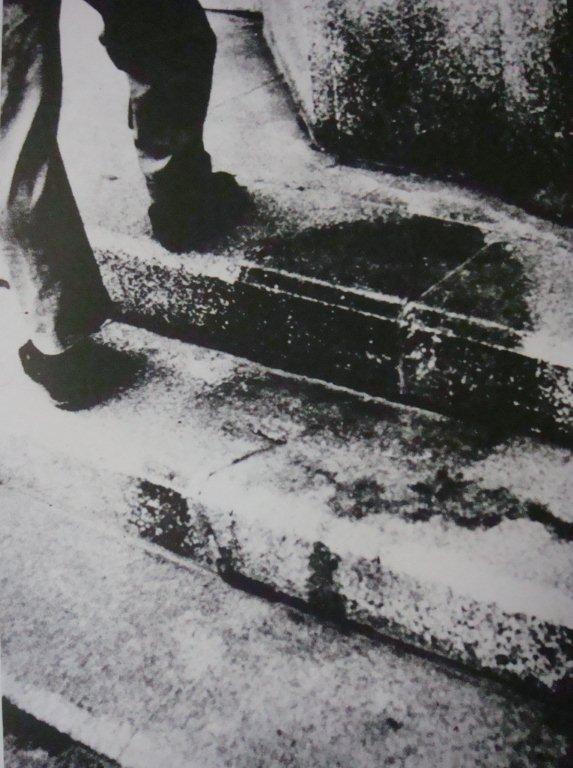
This is the shadow of a man (Shadow burnt into the granite steps).

Within 1.2 kilo-meters of ground zero, those who were directly affected by the heat rays suffered terrible burns and their internal tissues and organs severely damaged. Most of them died instantly or within a few days.

The explosion also created a powerful blast and destroyed most of the wooden houses in 2-kilometer radius of ground zero. People were blown through the air and many crushed to death under collapsed buildings.

Radiation left the human body with serious damage. It penetrated deeply into our bodies, damaged cells and diminished the blood generation function of bone marrow.

It also damaged inner organs. Even those who looked uninjured later became ill and died.

Residual radiation left on the ground affected many long after the explosion. Those who entered the city to search for their families/friends or for relief operations eventually developed similar symptoms and died.

Nuclear weapons are unspeakable weapons. They don’t allow us to live nor die as humans. They are weapons of absolute evil which can never co-exist with human beings.

3.2 million Japanese people lost their lives in the Asia-Pacific War. 20 to 30 million people were victimized by the Japanese military in Asia.

Learning from it, we have acquired the war-renouncing Japanese Constitution. However, military spending in the world is growing. Trillions of dollars are being spent for military purposes. If used for peaceful purposes, this money could solve many problems for human-kind.

20th century war is gone. Our responsibility is to hand over a peaceful and cultivated 21st century to the next generation. I strongly believe that we can hand over a nuclear-weapon-free world to future generations if we work together in solidarity with the people of the U.S. and with the people of the world.

Thank you.


****************
Click here to download the original program for Ms. Mizuno's presentation with the complete translation.

Click here to learn more about the Japan Council against Atomic and Hydrogen Bombs (Gensuikyo).

Friday, July 17, 2015

The Nuclear Age at 70; Time for Mandatory Retirement!

Yesterday marked the anniversary of the day in which the world entered the atomic age. On July 16, 1945, at 5:29:45 AM at the Alamogordo Test Range, on the Jornada del Muerto (Journey of Death) desert, in the test named Trinity, the experimental device known as the "Gadget" was detonated, creating a light "brighter than a thousand suns." A mere 6 kilogram (13.2 pound) sphere of plutonium, compressed to supercriticality by the surrounding high explosives, created an explosion equivalent to 20,000 tons of TNT (20 Kilotons). It was a stunning sight.

No one who saw it could forget it, a foul and awesome display.
- Kenneth Bainbridge, physicist
Was this, as thought nuclear physicist Robert Oppenheimer, the beginning of the end? These scientists had "become death", and they had created what could become (quite literally) "the destroyer of worlds"(Oppenheimer quoted a verse from the Bhagavad Gita which read, "I am become Death, the destroyer of worlds.")

Less than a month after the Trinity test, the United States dropped two atomic bombs - on the cities of Hiroshima and Nagasaki - that killed over 100,000 people in less time than it took me to type a few of these words. As many as 220,000 were dead from the effects of radiation by the end of 1945. Even today, 70 years later, survivors (the Hibakusha) and subsequent generations suffer the effects of radiation.

From its horrific beginnings the nuclear arms race has led humanity down a perilous road of preparation for its own destruction. Scientists have continued to seek the power of gods, creating ever more destructive nuclear devices over the years, and military planners continued asking for more of these awful weapons in every shape and form (and method of delivery).

The fall of the Berlin Wall provided an extraordinary opportunity for the U.S. to reach out to Russia to begin the process of bilateral disarmament that would have sent a clear signal to other nuclear armed nations, as well as the non-nuclear nations, that it was time to rid the world of the weapons of humanity's demise.

So why didn't this happen? The U.S. was so set on taking hold of the former Soviet republics, controlling resources in the region, and weakening the new Russian state that it barely throttled back on its nuclear weapons program. Oh yes, we cut back on the overall numbers of nuclear warheads and some delivery vehicles, Yet, the ICBM forces stayed (for the most part) on alert, and ballistic missile submarine (Trident) patrols have remained at near-Cold War levels to this day.

The nuclear weapons infrastructure has been in the process of rebuilding in recent years, a new generation of ballistic missile submarines is in the works, and other delivery systems are on the drawing boards. Is it any wonder then that other nations, including Russia, are building up their nuclear forces?

Of course, for the U.S., all this nuclear weapons modernization is about projecting force in our insane colonial quest to control resources around the world. The irony is that nuclear weapons do not provide any real security at all; they are only a liability, and their eventual use will mean the end of life on Earth as we know it. Don't future generations deserve better?

With the very real threats posed by Global Warming and its associated Climate Change, shouldn't we be spending our precious human and financial capital on works that will help humanity adapt and find sustainability in what will be a difficult enough future?

A new Cold War is brewing as the bomb approaches its 70th birthday. Is it not time to send this demonic creature into forced retirement and to transition the entire nuclear weapons infrastructure to sustainable industries and jobs to build a positive future for humankind?

Here in Washington State we have Naval Base Kitsap-Bangor and the Strategic Weapons Facility, Pacific. Bangor is home port to 8 of the nation's 14 ballistic missile (Trident) submarines, and the two facilities together represent the largest operational concentration of nuclear weapons in the U.S., and possibly anywhere in the world.

Trident is a first-strike weapon system designed during the height of the earlier Cold War in the bad old days of Mutually Assured Destruction (MAD). Those days are long gone, and with them any possible argument for the concept of Strategic Deterrence that continues to justify our nation's continued nuclear weapons modernization.

The Navy's plans for a successor to Trident, known as the OHIO Class Replacement, SSBN(X) or as I call it, "New Trident," are moving full speed ahead. Of course, the Russians are responding and building their submarine fleet (and the associated missiles) back up.

This madness must stop, or we will be assuring the eventual destruction of everything we hold dear. Ground Zero Center for Nonviolent Action has, for nearly four decades, resisted the Trident nuclear weapons system and worked for the abolition of all nuclear weapons, while grounding its work in the study and practice of nonviolence.

This August we will remember the atomic bombings of Hiroshima and Nagasaki on this 70th anniversary and continue to work to retire Trident and all nuclear weapons. 70 years is long enough (or perhaps I should say far too long).

Wherever you may be this August, I invite you to commemorate the 70th anniversary of the atomic bombings and begin or continue your work (in whatever way you are able) to rid the world of the scourge of nuclear weapons. There are events around the country, and you click here to find one thanks to Physicians for Social Responsibility.

While you're reading this, consider taking one of the actions (at the top of the right-hand column of this blog) to help build a nuclear weapons free world. You can also check out (and get involved at) our campaign to stop production of New Trident at NO To NEW TRIDENT.

Towards a peaceful retirement for the nuclear age,

Leonard

Wednesday, August 6, 2014

Bearing The Message of Abolition and Peace on Hiroshima Remembrance Day

Dear Friends,

Sixty-nine years ago today at appoximately 8:15am (Hiroshima time) the first atomic bomb was dropped on the city of Hiroshima.

The blast and firestorm caused by detonation of the bomb over the city left upwards of 80,000 people dead and 70,000 injured. Of the injured, many died in the subsequent days, weeks, months and years due to radiation-related effects.  The multigenerational effects of the radiation continue to cause suffering.

 
The survivors of the atomic bombings came to be known as Hibakusha (literally translated as "explosion-affected people").

Today we remember the victims of the atomic bombings, and to properly honor their memory we must recommit ourselves to ridding the world of these horrific weapons of extraordinary devastation.

Remembrance requires experience and the knowledge that flows from it. In the case of the atomic bombings, we can learn from the experience of those who were there, those who survived, suffering, and in some cases continue to suffer today.
 
This blog post holds the testimony of a survivor, a Hibakusha of HIroshima.  Ms. Tokie MIZUNO put the words of the story of her personal experience in the bombing of Hiroshima to paper for the first time in 2010. Her act preserves (and shares) her story and makes a plea for us all to find our common humanity and work for peace and the abolition of nuclear weapons.


Tokie MIZUNO giving her testimony in May 2010
It has taken great courage for these Hibakusha to pass on their difficult and painful stories. They make us see (and feel) the horrors of nuclear war and hopefully mobilize our hearts to action. Nuclear weapons are the ultimate expression of violence, capable of extinguishing life as we know it. Nuclear weapons are incompatible with life!

Ms. MIZUNO represents all Hibakusha in saying, “No more Hiroshimas, No more Nagasakis!” All who read her testimony become witnesses to it, and as witnesses it is my deepest hope that we will all share her story far and wide, spreading her message, and the message of the Japan Council against Atomic and Hydrogen Bombs (GENSUIKYO), a message of peace.

With great thanks to Tokie MIZUNO, Hibakusha of Hiroshima.

May we all rise up and say (and work for "No more Hiroshimas, No more Nagasakis!"

Peace,

Leonard

Testimony of Tokie MIZUNO,
 Hibakusha of Hiroshima


My name is Tokie MIZUNO and I am a survivor of Hiroshima. 65 years ago, when I was 5 years old, the atomic bomb was dropped on my city, Hiroshima. I was near my grandmother’s house, 1.2 kilo-meters from ground zero.

The City of Hiroshima was completely destroyed and was turned into rubble by the enormous destructive power of the atomic bomb. As other survivors, I was barely alive and the damage on my body and mind was unbearable.

I might have been lucky to survive but life hasn’t been easy on me financially, physically and mentally. This agony should not be repeated on anybody else on earth. That’s why I have become involved in anti-nuclear actions with other Hibakusha as well as many other Japanese people.

We have been collecting signatures for a nuclear-weapon-free world, and engaging in activities to defend the Japanese Constitution, especially the Preamble and Article 9, which pledges never to wage war again.

Article 9 of the Japanese Constitution clearly states “the Japanese people forever renounce war as a sovereign right of the nation and the threat of use of force as means of settling international disputes.”

And it adds “In order to accomplish the aim of the preceding paragraph, land, sea, and air forces, as well as other war potential, will never be maintained.” Article 9 is our treasure.

This treasure for Japan was achieved with the sacrifice of precious lives of 20 to 30 million people in Asia and Pacific. This is one of the greatest achievements for the world, too, and we will hold on to it forever.

Let me talk about that day.......

On the morning of August 6th, 1945, just before Hiroshima was hit by the atomic bombing, one of the women in my neighbourhood came to my house and said “We have some sweets. Why don’t you come and have some?”

So my little 3-year-old brother and I happily followed her. In those days it was very difficult to have sweets. My neighbour’s son, a soldier, was back from the battlefront to treat his wounds. He brought some sweets with him for his family and the neighbour invited us in.

We were about to eat our sweets when the bomb exploded.

With a blinding flash, the whole house was flattened.

I found myself trapped under the rubble. I tried to look out from my little prison and saw my younger brother, rescued by a soldier, standing there with blood on his face and head.

I myself was pulled out of the rubble. My right arm was heavily injured and I had several cuts on my face. My neighbour tore her underwear into pieces and covered my arm to stop it bleeding. Later I was told that it was her treatment that saved my right arm.

I don’t remember how many hours had passed, but I saw my mother crawling to me over piles of rubble. She was desperately looking for me and my younger brother. She looked awful with only tattered patches of her clothing on her body and her hair standing on end.

My 12-month-old baby brother was still buried under the rubble. My mother and grandmother were desperate and were removing the debris saying they should get him back home, even if he was dead.

They also called out for help to people walking by but nobody stopped. They went on their way absentmindedly - they were like ghosts.

We saw flames in the distance coming towards us. Terrified, my younger brother and I were both crying. I don’t remember the pain of my injury, but many collapsed houses around us horrified me, although my father thought I was just stunned.

Fortunately, my baby brother was alive, and we managed to escape to a raft on the river. There were countless dead bodies floating and fire balls were falling all around. Red-hot galvanized plates darted towards us and made a huge noise when they dropped into the river. It was not a safe place to be.

At that time I was so young that I don’t remember exactly what happened. But my deceased parents and grandmother told me a lot about that day.

There was a woman on the raft who gave us food and water. She also gave my mother part of a Kimono to use as bandages and as a strap to carry me on her back.

In the evening, cooling our bodies with river water, we finally found a place to evacuate to. It was a shrine near a railway station called Koi.

Because my grandmother and I were seriously injured, we two were left at the shrine while my mother and brothers escaped to my aunt’s house in Itsukaichi City. My uncle who rushed to Hiroshima to search for us carried them on his handcart.

Grandmother thought we could have some treatment at the shrine but nothing was available. We were given only one rotten rice ball. We finally evacuated to my aunt’s house.

They were farmers and gave us good food. I had tomatoes, cucumbers, pickled shallots etc. to my heart’s content. It may be this diet that has kept me healthy.

My father had to spend several nights at shelters in Hiroshima. He died abruptly from TB in August 1956, which we believe was due to residual radiation. Later when I was working to collect survivors’ stories, I learned that there were many Hibakusha who suffered from TB during those difficult times.

My mother died in Oct. 1967. I believe that both of my parents were killed by the atomic bomb. At that time I thought that it was our fate and that because Japan was at war we couldn’t complain about it.

I also thought we were just unfortunate because we were in Hiroshima when the atomic bomb was dropped. Later I learned history, which completely changed my mind. I knew why the US had done it.

The US government has kept saying that the atomic bombing of Hiroshima and Nagasaki ended the war and saved millions of people’s lives. That’s what they teach at schools.

However, in 1944 there was scarcely any food left for Japanese people. People were dying from hunger. Japan’s ground and air forces and navy were almost completely destroyed. It was obvious that Japan was finished.

Nonetheless, 210,000 people were killed in Hiroshima and Nagasaki. Why?

In 1945 the war ended, but another war, the Cold War between the US and the Soviet Union had already started. The US wanted to have an advantage over the Soviet Union militarily and politically by showing the power of nuclear weapons. They also wanted to test their newly developed technology, atomic bombs.

Hiroshima and Nagasaki were chosen as testing grounds with real live people.

Let me share with you what the atomic bombing had done to us. The atomic bomb caused massive destruction and killed tens of thousands instantly and indiscriminately. It also emitted massive amounts of radiation which has afflicted us for decades.

Hibakusha describe the moment of the bombing as “The Sun dropped on us and burnt us”. When Bomb exploded, a huge fireball, 280 meters in diameter, was generated in the air.

Heat rays emitted from it raised the ground temperature, from 3000 to 4000 degrees Celsius (5500 to 7300 degrees Fahrenheit) near the hypocenter.

This was a boy, the charred remains. 700 meters from the hypocenter (Aug. 10. Nagasaki).


This is the shadow of a man (Shadow burnt into the granite steps.

Within 1.2 kilo-meters of ground zero, those who were directly affected by the heat rays suffered terrible burns and their internal tissues and organs severely damaged. Most of them died instantly or within a few days.

The explosion also created a powerful blast and destroyed most of the wooden houses in 2-kilometer radius of ground zero. People were blown through the air and many crushed to death under collapsed buildings.

Radiation left the human body with serious damage. It penetrated deeply into our bodies, damaged cells and diminished the blood generation function of bone marrow.

It also damaged inner organs. Even those who looked uninjured later became ill and died.

Residual radiation left on the ground affected many long after the explosion. Those who entered the city to search for their families/friends or for relief operations eventually developed similar symptoms and died.

Nuclear weapons are unspeakable weapons. They don’t allow us to live nor die as humans. They are weapons of absolute evil which can never co-exist with human beings.

3.2 million Japanese people lost their lives in the Asia-Pacific War. 20 to 30 million people were victimized by the Japanese military in Asia.

Learning from it, we have acquired the war-renouncing Japanese Constitution. However, military spending in the world is growing. Trillions of dollars are being spent for military purposes. If used for peaceful purposes, this money could solve many problems for human-kind.

20th century war is gone. Our responsibility is to hand over a peaceful and cultivated 21st century to the next generation. I strongly believe that we can hand over a nuclear-weapon-free world to future generations if we work together in solidarity with the people of the U.S. and with the people of the world.

Thank you.

Monday, August 12, 2013

International Declaration of 2013 World Conference against A and H Bombs

Editor's Note: This is a message from the World Conference against A & H Bombs Organizing Committee following the completion of the World Conference against A and H Bombs.

Declaration of the International Meeting

Sixty-eight years have passed since Hiroshima and Nagasaki suffered the atomic bombings.  The bombs instantly devastated the two cities and took lives of over 200,000 citizens by the end of 1945.  They created a “hell on earth,” which denied humans either to live or die as humans.  The Hibakusha, who survived the days have continued to suffer from wounds in both mind and body.  The tragedy like this should never be repeated anywhere in the world.
            Nuclear weapons are the worst weapons of mass destruction, the use of which is a serious crime against humanity.  They have to be banned without any further delay.
            There are still nearly 20,000 nuclear weapons in the world.  One nuclear bomb, if used, could cause disastrous tragedy.  Even a small portion of them would cause a large scale climate change, which could lead to famine around the world.  Total ban and the elimination of nuclear weapons is an urgent task for the whole of humanity.
            Along with the survivors and on behalf of those who died and cannot speak for themselves, we, participants in the International Meeting of the 2013 World Conference against A and H Bombs appeal to all governments to take actions now to achieve a “world without nuclear weapons.”

The demand for a world without nuclear weapons represents an unshakable international development.  The General Assembly of the United Nations every year adopts resolutions calling for the elimination of nuclear weapons.  The 2010 NPT Review Conference resolved by consensus, with all nuclear weapon states included, to achieve a “world without nuclear weapons”, and affirmed that all States need to make “special efforts” to establish a “framework” to achieve it.
            However, primarily due to the intransigence of nuclear powers, no tangible progress has been made.  We call on the international community to overcome all stagnations and resistance.
            On the governmental level, a movement to seek to outlaw nuclear weapons by focusing on their atrocious, inhuman nature is rapidly gathering momentum.  Such is the approach which our movement has adopted and pursued with the Hibakusha since its outset.  The resolution calling for the start of negotiations on a Nuclear Weapons Convention, in line with the decision by the ICJ, which the peace movement of the world demands, now commands support of 135 governments, representing over 70% of all U.N. member States.
            By continuing these developments, a nuclear weapon-free world can be created.  The key lies in the hands of the peace movement and public support across the world.
            We call on all governments, and those of the nuclear weapon states in particular, to begin to implement the agreement for “achieving the peace and security of a world without nuclear weapons” by starting negotiations on the Nuclear Weapons Convention as the framework of it.
            Towards 2015, which will mark the 70th anniversary of the A-bomb suffering of the two cities and in which the next NPT Review Conference will examine how the 2010 agreement has been implemented, let us develop our campaign in each of our countries and bring strong voices of the citizens of the world to New York, to generate a huge ground swell demanding the total abolition of nuclear weapons.

The policy of “nuclear deterrence”, aimed to threaten adversaries with nuclear weapons, contravenes the basic principle of the U.N. Charter, which stands for the solution of international conflicts by peaceful and diplomatic means as opposed to the use of force.  It also serves as incentive for nuclear proliferation.  A world without nuclear weapons is incompatible with the nuclear deterrence doctrine, which should be overcome immediately.
            We call for the problem of North Korea’s nuclear weapons to be solved peacefully on the basis of international agreements reached particularly by the Six-party talks.  An international conference to establish a WMD-free zone in the Middle East should be convened as agreed by the previous NPT Review Conferences. Steps forward toward a total ban on nuclear weapons would provide new favorable conditions for the solution of these specific problems.
            International conflicts can only be resolved by diplomatic and peaceful means.  Threat or use of force would create a vicious cycle of heightened tension and aggravated situation.  We note the frameworks of and efforts for peace, which are developing in the Southeast Asia, Latin America and other places.  Opposing arms build-up and reinforcement of military alliances, we make a strong call for no-use of force and peaceful settlement of conflicts. 
           
In achieving a nuclear weapon-free world, the A-bombed country Japan, which can denounce the cruelty of nuclear weapons through its own experiences, should play a significant role.  However, the government of Japan continues to abstain from voting for the U.N. resolutions calling for the start of negotiations on a Nuclear Weapons Convention or calling for prohibition on the use of nuclear weapons, and for other resolutions leading to the abolition of nuclear weapons, including one for nuclear disarmament tabled by the Non-Aligned movement.  Japan’s refusal to join the statement (supported by 80 countries) warning of the humanitarian impact of nuclear weapons and calling for their elimination drew deep disappointment and criticism.
            The Japanese peace movement calls on the government to play the role befitting the A-bombed country and demands strict observance of the Three Non-Nuclear Principles and breaking away from the U.S. “nuclear umbrella.”  Noting its important role, we extend solidarity with the movement for a nuclear weapon-free and peaceful Japan.  We support the Hibakusha in their efforts to achieve relief measures based on State compensation and fundamental reform in the A-bomb disease recognition system.
            Article 9 of the Constitution of Japan, upholding the renunciation of war and non-possession of war potentials, embodies a strong commitment of the Japanese people to reject war and recurrence of Hiroshima and Nagasaki.  We express our support to the people of Japan in their endeavors to defend and make the most of the Constitution, to reduce and remove U.S. military bases from Okinawa and elsewhere, and to resist the consolidation of Japan-U.S. military alliance.
            The accident at the Fukushima Daiichi Nuclear Power Plant is still in the midst of the crisis.  Bringing the situation under control, decommissioning of all nuclear reactors and a fundamental shift to renewable energy resources are keenly called for.  Having noted the dangerous relations between nuclear weapons and nuclear power generation, we call for ending all kind of nuclear damage caused by nuclear fuel cycles, and oppose reprocessing of spent nuclear fuel and accumulation of plutonium, as well as military use of nuclear energy.

We call on the peoples of the world to join in the following actions:

  • Towards 2015, let us urge the nuclear weapon states and all other governments to implement their agreement to achieve a world without nuclear weapons.  In every country, we must inform wider public of the atrocity and inhumanity of nuclear weapons and strengthen the public opinion in support of the abolition of nuclear weapons.  Organizing “A-bomb damage exhibitions” and Hibakusha testimonies, let us inform the public of the consequences of Hiroshima and Nagasaki.  Let us promote international signature campaign in support of the “Appeal for a Total Ban on Nuclear Weapons” and other activities to urge the start of negotiations for a Nuclear Weapons Convention.  Let us organize many varieties of actions which everyone at grassroots can take part in, such as peace marches, by making use of social media and other means.  And let us deepen cooperation with the U.N. and other international organizations, national governments and local authorities that stand for nuclear disarmament, including Mayors for Peace.
  • Strengthening relief and solidarity with the Hibakusha, let us extend our support and solidarity to all nuclear victims.  We will support the victims of Agent Orange, depleted uranium and all other remnants of war.
  • United in one wish for “no more nuclear victims,” we will develop our campaign together with the movement to break free of nuclear power.  We work together with broadest range of people demanding reduction of military spending, better life and employment, welfare, freedom and democracy, defending human rights, protecting global environment and overcoming gender-based discrimination and social injustice.  Let us create a far-reaching unity and solidarity for a “nuclear weapon-free, peaceful and just world.”
Together with younger generation, once again, let us listen to the Hibakusha and turn our eyes to the “hell” created by nuclear weapons.  Moving the hearts of tens of millions of people, we shall build up powerful public pressure to open the door to a nuclear weapon-free world.

No more Hiroshimas!  No more Nagasakis!  No more Hibakusha!

August 5, 2013
International Meeting, 
2013 World Conference against Atomic and Hydrogen Bombs

Saturday, April 13, 2013

Gensuikyo Calls for a Total Ban on Nuclear Weapons

Dear friends, Japan Council against A and H Bombs (Gensuikyo) issued the following "Letter to the Heads of the Five Nuclear Weapon States," when the second PrepCom of the NPT is just around the corner. The letter was addressed to US President Barack Obama, Russian President Vladimir Putin, French President Francois Hollande, UK Prime Minister David Cameron and Chinese President Xi Jinping. We visited the embassies of P5 in Tokyo on April 5, 8 and 9, 2013 and handed it over to them. The copy of the letter was also sent to UN Secretary General Ban Ki-moon on April 10. We sent the letter in the hope that P5 will take initiatives to achieve an agreement for a total ban on nuclear weapons at the forthcoming Second NPT PrepCom or at the sessions of the UNGA and the UN Security Council, so that the 2015 NPT Review Conference will become a place to launch actions for definitely attaining the “peace and security of a world without nuclear weapons.”

 :::::::::::::::::::::::::::::::::::::::::::::::::::::::

Letter to the Heads of the Five Nuclear Weapon States

Decision and Action Now for a Total Ban on Nuclear Weapons

April 2013 
Japan Council against Atomic and Hydrogen Bombs 

It will soon be the 68th summer since Hiroshima and Nagasaki were obliterated by two atomic bombs.

With call of the survivors who witnessed the “nuclear hell” for “No more Hiroshimas, No more Nagasakis, No more Hibakusha” and mounting public support for them, a historic momentum is building up to achieve the abolition of nuclear weapons.

The NPT Review Conference of May 2010 agreed to “achieve the peace and security of a world without nuclear weapons” and declared, “all States need to make special efforts to establish the necessary framework to achieve and maintain a world without nuclear weapons.”


gensuikWith the 2015 NPT Review Conference approaching, the governments and civil society must take actions in unison to bring this goal to a reality. So far, although three years have elapsed since then, the path to reach this goal is not yet in sight. True, a certain number of nuclear weapons, including those dealt between the U.S. and Russia, were cut down, but still some 19,000 nuclear warheads are stockpiled or deployed. Even such moves as acquiring nuclear weapons are continuing, as seen in the current tension on the Korean Peninsula. Whether intentional or accidental, the danger of nuclear weapons actually being used remains real.  

Why does such a situation continue? It is because of the lack of an agreement for a total ban on nuclear weapons in international politics. The use of nuclear weapons is a crime against humanity, threatening the survival of the human community and civilization. It is “contrary to the rule of international law …, and in particular the principles and rules of humanitarian law,” as declared by the International Court of Justice. History tells us that the claim of the nuclear powers that their nuclear weapons are for deterrence to guarantee security is “contagious." It pushes the threatened side to seek the same “guarantee of security.”

In order to eliminate nuclear weapons, the only way is to totally prohibit them. The United Nations is called on to unanimously confirm this and take actions to achieve a nuclear weapons convention (NWC). The Security Council, especially its five permanent members, which are the nuclear weapon states, bears special responsibility to exert leadership to this end. They must recall the fact that the Security Council Summit held in September 2009 agreed to “create the conditions for a world without nuclear weapons” and confirmed the obligation to pursue negotiations for nuclear disarmament mandated by Article 6 of the NPT.


The conditions for totally banning nuclear weapons are ripe:
    -- At the General Assembly of the United Nations, the resolutions calling for nuclear weapons abolition all command overwhelming majority support. At its 67th session, the proposer of the New Agenda Coalition resolution, which was supported by 175 member states, emphasized the need to set "timelines” and a “legally-binding framework” for this.
    -- The statement warning of the inhumanity of nuclear weapons use and calling for efforts to outlaw them is supported worldwide. In addition, many countries are taking part in work for consultation and negotiations, including one leading to nuclear weapons abolition.
    -- Of the 190 States parties to the NPT, 185 states have undertaken the obligations of Article 2 as the “non-nuclear weapon states,” renouncing the acquisition, development or possession of nuclear weapons. -- India and Pakistan, which are non-parties to the NPT, and North Korea, which has declared to withdraw from the NPT, voted in favor of the UN resolution (A/C. 1/67/L9) calling for a start of negotiations leading to a nuclear weapons convention.

These facts prove that if the five nuclear weapon states make a decision, the U.N. Security Council or General Assembly can confirm in consensus the need to totally ban nuclear weapons. Based on that, negotiations for a NWC can be launched.

We must point out that any further delay in this decision and actions is tantamount to neglecting the danger of causing a second or third Hiroshima or Nagasaki.

In August 2010, Mr. Ban Ki-moon, as the first U.N. Secretary-General to visit Hiroshima, renewed his determination to achieve a “world without nuclear weapons.” In support of the proposal by the mayors of Hiroshima and Nagasaki calling for the “abolition of nuclear weapons by 2020,” he invited the world to join together with the Hibakusha on the 75th anniversary of the bombing to celebrate the end of nuclear weapons.

After two more annual Preparatory Committee meetings, the next NPT Review Conference will be held in 2015. The focal point of the Conference will be how much the agreement of achieving “the peace and security of a world without nuclear weapons,” placed in the first line of the “Principles and Objectives” of the 2010 Review Conference document, will have been achieved. The determination and effort to that end by the five nuclear weapon states would also promote the implementation of the specific agreements, including the ratification and entry into force of the Comprehensive Test Ban Treaty, the start of negotiations for a Fissile Material Cutoff Treaty and the convening of an international conference on the establishment of a Middle East zone free of nuclear weapons and all other weapons of mass destruction, and help eradicate the danger of nuclear proliferation.

For the reasons above, we sincerely appeal that you take initiatives to achieve an agreement for a total ban on nuclear weapons at the forthcoming Second PrepCom of the NPT and the sessions of the U.N. General Assembly in autumn and in the Security Council, so that the 2015 NPT Review Conference will become a place to launch actions for definitely attaining the “peace and security of a world without nuclear weapons.”

 CC: Mr. Ban Ki-moon, Secretary-General of the United Nations =============================================
Japan Council against A & H Bombs (GENSUIKYO)
2-4-4 Yushima, Bunkyo-ku, Tokyo 113-8464 JAPAN
phone: +81-3-5842-6034
fax: +81-3-5842-6033
Email: antiatom@topaz.plala.or.jp  
URL: http://www.antiatom.org/

Tuesday, August 14, 2012

Declaration of the 2012 World Conference against Atomic and Hydrogen Bombs

2012 World Conference against Atomic and Hydrogen Bombs

Declaration of the International Meeting

Sixty-seven years after the US atomic bombs were dropped on Hiroshima and Nagasaki, about 20,000 nuclear weapons are still threatening the very survival of the human race. This threat must be rooted out as soon as possible. We call on people around the world to work together to achieve a world without nuclear weapons. The accident of the Fukushima Daiichi Nuclear Power Plant on March 11, 2011 has brought the horror of the nuclear dangers into sharper relief. We extend our solidarity with all nuclear victims.

Throughout the world, people are taking actions demanding their freedom and dignity, opposing social inequality and poverty, and for an end to war and occupation. In Japan, which has suffered the tragedies of Hiroshima, Nagasaki and Bikini, actions of citizens demanding zero nuclear power plants are developing on an unprecedented scale since the outbreak of the Fukushima Daiichi NPP accident, to the level of shaking the entire nation. The voices of the citizens are changing the course of the future of countries and the world.

The call for “No More Hibakusha, No More Hiroshimas and Nagasakis” is heard around the world in this development. The intense desire of the civil society, expressed by signatures collected on streets, in workplaces and campuses, is meeting positive responses in the international politics.

The present situation calls for a drastic strengthening of peace movement and public support. The NPT Review Conference in 2010 reached an agreement to achieve the “peace and security of a world without nuclear weapons”. The focus now is on the implementation of this agreement. With the start of the preparatory process for the next NPT Review Conference in 2015, many non-nuclear-weapon states governments are resolved to move the situation forward. Sixteen nations, including Non-Aligned and New Agenda Coalition states as well as NATO members, together made an appeal for a ban on nuclear weapons, focusing on the humanitarian dimension of the use of nuclear weapons. It is time now that the civil society, local governments, the United Nations and national governments should join forces to open a door of a “world without nuclear weapons”.

The use of nuclear weapons can never be justified for any reason whatsoever. One nuclear bomb, if used, would cause catastrophic consequences, which the Hibakusha called a “hell on earth”. It is a crime against humanity and civilization. The disasters of Hiroshima and Nagasaki, where people could not live as humans or die as humans, continue to warn the human race of that. The serious consequence of the nuclear power plant accident also shows how inhumane it is to use nuclear energy for military purpose. Nuclear weapons and humans cannot coexist. Retaining such weapons is morally unacceptable.

Inhuman and immoral as they are, nuclear weapons are to be banned by law and eliminated. We call for the start of negotiations for a nuclear weapons convention, to establish the rule of law. In the UN General Assembly, 130 countries voted in support of the resolution for it, and the NPT Review Conference in 2010 called on all countries to make “special effort” to establish a “framework” to create a “world without nuclear weapons”. The agreement should be honored and implemented.

With public opinion for a total ban on nuclear weapons growing, there is a strong resistance to maintain nuclear arsenals. Some nuclear powers and their allies insist on their “nuclear deterrence” and maintain their nuclear alliance and “nuclear umbrella”. The highly expensive modernization of nuclear weapons continues. In no sense does nuclear arsenal guarantee peace or security. They should face up to the reality that the nuclear deterrence policy has actually helped nuclear proliferation accelerate. Only when nuclear deterrence doctrines are overcome, can the “peace and security of a world without nuclear weapons” be achieved. Peace movements and public support will play the key role here. It is important that an international conference on a nuclear weapon-free zone in the Middle East, as set out by the NPT Review Conference, should achieve a good success. We support the call for the signing of the protocol of the South East Asian Nuclear Weapon-Free Zone Treaty by the nuclear weapon states. We oppose NATO’s nuclear doctrine and interventionism and demand the withdrawal of tactical nuclear weapons from Europe. We support the denuclearization of Korean Peninsula.


Lasting peace and security cannot be achieved by force. We oppose the use or threat to use forces and demand the resolution of all conflicts by diplomatic and peaceful means. We support a world order of peace based on the UN Charter and other instruments of international law. We oppose foreign military bases and demand their withdrawal. In solidarity with the effort for independent and democratic changes in the Middle East countries, we call for a peaceful solution of the problem in Syria without outside military intervention. We demand a peaceful and diplomatic solution on the problems on Iran.

In order for the Japanese government to take actions commensurate to the only A-bombed country, the role of the Japanese peace movement is becoming ever more important. We extend our support and solidarity to the movements for the abrogation of the Japan-US “secret nuclear arrangements”, which allow nuclear weapons to be brought into Japanese territories; for the strict observance of the “Three Non-Nuclear Principles”; for establishing a nuclear weapon-free Japan; the opposition by the people of Okinawa and other communities involving local authorities to the deployment of the dangerous US new transportation aircraft Osprey and to the deployment or port calls of US nuclear-powered warships; the movement demanding the removal of the Futenma base in Okinawa and other US military bases in Japan and for defending and having fully operated Article 9 of the Japanese Constitution.

The accident of the Fukushima Daiichi NPP has brought the danger of nuclear power plant into clear view. The procurement of the energy sources for sustainable development, without relying on NPP and without thus leaving the danger to the future generations is the necessity. We work for the eradication of the nuclear damage stemming from each stage of the nuclear fuel cycle. Noting the link between nuclear weapons and nuclear power plants, we oppose the reprocessing of spent nuclear fuel, the accumulation of plutonium and the military use of nuclear energy. We express our solidarity with the idea for a nuclear-free world.

We propose the following actions worldwide:

-- Let us build up international opinion demanding the start of negotiations for a nuclear weapons convention by collecting signatures in support of the “Appeal for a Total Ban on Nuclear Weapons” and many other actions. Let us develop campaigns in different countries and regions in demand for the removal of nuclear weapons and for nuclear free zones.

-- Let us further develop our effort to make known to the public the consequences of the A-bombings of Hiroshima and Nagasaki through A-bomb photo exhibitions. The truth on the suffering from the A-bombs renders every excuse on nuclear weapons meaningless. Let us strengthen support and solidarity with the Hibakusha, from which the World Conference against A and H Bombs and its movement started. Struggling against cover-up or underestimation of the effects of nuclear damage, we will strengthen solidarity with all nuclear victims. Let us work in solidarity with the movements for support of the victims of Agent Orange and other war atrocities.

-- We will develop solidarity with a broad range of movements for a shift from nuclear power to renewable energy resources. No more nuclear victims of any kind is a shared desire of the movements against nuclear weapons and for zero nuclear power plants. Let us keep building these movements to open the way to a future with no more nuclear damage.

We oppose disparity of wealth and growing social inequality. Hands in hands with all people who stand for freedom, democracy and demilitarization, working against hunger, poverty, unemployment, illiteracy and for the resolution of social injustices, drastic cuts in military spending and armament, for the improvement of social welfare, human rights, protection of global environment, overcoming of patriarchal structure and for the rights and equal social status of women, let us open a door to a nuclear weapon-free, peaceful and just world.

With the Hibakusha, and with the young generation who bear the future, let us make strides forward.

August 4, 2012
International Meeting
2012 World Conference against A & H Bombs