PLEASE NOTE!

I am no longer coordinating communications for Ground Zero Center for Nonviolent Action, where I worked for nearly two decades. Although on a sabbatical from full-time nuclear abolition work, I will still be doing some research and writing on the subject, and will occasionally post here at the Nuclear Abolitionist. Thanks and Peace, Leonard

Sunday, September 22, 2013

No Margin of Error with Nuclear Weapons

Eric Schlosser, better known for his book Fast Food Nation, has a new book out - Command and Control Nuclear Weapons, the Damascus Accident, and the Illusion of Safety.  One review called Schlosser's new book "Vivid and unsettling... An exhaustive, unnerving examination of the illusory safety of atomic arms."  And "unnerving" it should be.  Even since the publication of Schosser's book, we continue to hear of problems with nuclear weapons safety.

Much of the risk surrounding nuclear weapons comes down to human error, and as they say, "to err is human."  Whether in the design, production, maintenance or deployment of nuclear weapons, there are countless points at which human error can come into play. The bottom line is - with weapons that, if ever accidentally detonated, would have horrific consequences - there is little (if any) acceptable margin of error.

The following article in Global Security Newswire highlights the most recent failure of those charged with the stewardship of one-third of the nation's Intercontinental Ballistic Missiles (ICBMs).  The commander of Air Force Global Strike Command downplayed this most recent failure and "said that the number of problems at the nuclear wings has decreased since his command was established in 2009." Don't we all feel safer now???

P.S. - Eric Schlosser will be at the Central Seattle Public Library on October 1st to talk about his new book.  Click here for all the information.

Click here to read a recent (September 16th) interview with Schlosser by Global Security Newswire.

**********************

In New Setback, Air Force Missile Team Fails Security Drill
Global Security Newswire, August 14, 2013

An Air Force unit that oversees one-third of America's land-based nuclear missiles failed a safety and security inspection, constituting the second serious Minuteman 3 mission readiness problem this year, the Associated Press reported on Tuesday.

Lt. General James M. Kowalski, commander of Air Force Global Strike Command -- an organization created in 2009 as part of a broad effort to alleviate problems in the service's nuclear mission -- told AP that a team of "relatively low-ranking" airmen stationed at Malmstrom Air Force Base, Mont., "did not demonstrate the right procedures" in a single exercise. The drill was part of a more expansive inspection that started last week and ended on Tuesday.

Technicians remove the upper section of an ICBM
at Malmstrom Air Force Base in Montana.
Missile personnel at the site have failed a
safety and security check that concluded
on Tuesday, a senior Air Force officer said
(AP Photo/U.S. Air Force).
A written statement posted on the command's website said the 341st Missile Wing received an unsatisfactory rating after making "tactical level errors -- not related to command and control of nuclear weapons -- during one of several exercises conducted during the inspection. This failure resulted in the entire inspection being rated 'unsatisfactory.'"

The wing is one of three that control 450 Minuteman 3 ICBMs, according to AP.

The Air Force is "looking into" the possibility of disciplinary action against the 341st, Kowalski told the wire service. He noted, though, that the wing did well overall, scoring excellent or outstanding in most of the 13 areas being tested.

In March, the deputy commander of the 91st Missile Wing -- stationed at Minot Air Force Base, N.D. -- complained of "rot" in the group after an inspection gave its missile crews the equivalent of a "D" grade on Minuteman 3 launch operations, according to AP. Although the 91st passed that inspection, the failed simulation of ICBM launch operations resulted in the temporary removal and retraining of 19 personnel.

In 2008, the 5th Bomb Wing at Minot failed the nuclear security component of an inspection.

Eric Fanning, acting secretary of the Air Force, will travel to Barksdale Air Force Base, La., on Wednesday to meet with Kowalski and discuss specifics of the Malmstrom case, as well as aspects of the overall nuclear mission, top Air Force spokesman Brig. Gen. Les Kodlick told AP. The trip was planned prior to the latest incident.

The Air Force nuclear mission has hit a number of bumps since 2008, including a B-52 bomber flight over several U.S. states during which the crew was unaware that actual weapons were onboard.

In an interview on Tuesday, Kowalski said that the number of problems at the nuclear wings has decreased since his command was established in 2009, AP reported. The occasional failures do not point to a wide-reaching failure to follow safety and security protocols, the general asserted.

Source URL: http://www.nti.org/gsn/article/safety-and-security-inspection-failed-air-force-nuclear-unit/

Monday, August 12, 2013

International Declaration of 2013 World Conference against A and H Bombs

Editor's Note: This is a message from the World Conference against A & H Bombs Organizing Committee following the completion of the World Conference against A and H Bombs.

Declaration of the International Meeting

Sixty-eight years have passed since Hiroshima and Nagasaki suffered the atomic bombings.  The bombs instantly devastated the two cities and took lives of over 200,000 citizens by the end of 1945.  They created a “hell on earth,” which denied humans either to live or die as humans.  The Hibakusha, who survived the days have continued to suffer from wounds in both mind and body.  The tragedy like this should never be repeated anywhere in the world.
            Nuclear weapons are the worst weapons of mass destruction, the use of which is a serious crime against humanity.  They have to be banned without any further delay.
            There are still nearly 20,000 nuclear weapons in the world.  One nuclear bomb, if used, could cause disastrous tragedy.  Even a small portion of them would cause a large scale climate change, which could lead to famine around the world.  Total ban and the elimination of nuclear weapons is an urgent task for the whole of humanity.
            Along with the survivors and on behalf of those who died and cannot speak for themselves, we, participants in the International Meeting of the 2013 World Conference against A and H Bombs appeal to all governments to take actions now to achieve a “world without nuclear weapons.”

The demand for a world without nuclear weapons represents an unshakable international development.  The General Assembly of the United Nations every year adopts resolutions calling for the elimination of nuclear weapons.  The 2010 NPT Review Conference resolved by consensus, with all nuclear weapon states included, to achieve a “world without nuclear weapons”, and affirmed that all States need to make “special efforts” to establish a “framework” to achieve it.
            However, primarily due to the intransigence of nuclear powers, no tangible progress has been made.  We call on the international community to overcome all stagnations and resistance.
            On the governmental level, a movement to seek to outlaw nuclear weapons by focusing on their atrocious, inhuman nature is rapidly gathering momentum.  Such is the approach which our movement has adopted and pursued with the Hibakusha since its outset.  The resolution calling for the start of negotiations on a Nuclear Weapons Convention, in line with the decision by the ICJ, which the peace movement of the world demands, now commands support of 135 governments, representing over 70% of all U.N. member States.
            By continuing these developments, a nuclear weapon-free world can be created.  The key lies in the hands of the peace movement and public support across the world.
            We call on all governments, and those of the nuclear weapon states in particular, to begin to implement the agreement for “achieving the peace and security of a world without nuclear weapons” by starting negotiations on the Nuclear Weapons Convention as the framework of it.
            Towards 2015, which will mark the 70th anniversary of the A-bomb suffering of the two cities and in which the next NPT Review Conference will examine how the 2010 agreement has been implemented, let us develop our campaign in each of our countries and bring strong voices of the citizens of the world to New York, to generate a huge ground swell demanding the total abolition of nuclear weapons.

The policy of “nuclear deterrence”, aimed to threaten adversaries with nuclear weapons, contravenes the basic principle of the U.N. Charter, which stands for the solution of international conflicts by peaceful and diplomatic means as opposed to the use of force.  It also serves as incentive for nuclear proliferation.  A world without nuclear weapons is incompatible with the nuclear deterrence doctrine, which should be overcome immediately.
            We call for the problem of North Korea’s nuclear weapons to be solved peacefully on the basis of international agreements reached particularly by the Six-party talks.  An international conference to establish a WMD-free zone in the Middle East should be convened as agreed by the previous NPT Review Conferences. Steps forward toward a total ban on nuclear weapons would provide new favorable conditions for the solution of these specific problems.
            International conflicts can only be resolved by diplomatic and peaceful means.  Threat or use of force would create a vicious cycle of heightened tension and aggravated situation.  We note the frameworks of and efforts for peace, which are developing in the Southeast Asia, Latin America and other places.  Opposing arms build-up and reinforcement of military alliances, we make a strong call for no-use of force and peaceful settlement of conflicts. 
           
In achieving a nuclear weapon-free world, the A-bombed country Japan, which can denounce the cruelty of nuclear weapons through its own experiences, should play a significant role.  However, the government of Japan continues to abstain from voting for the U.N. resolutions calling for the start of negotiations on a Nuclear Weapons Convention or calling for prohibition on the use of nuclear weapons, and for other resolutions leading to the abolition of nuclear weapons, including one for nuclear disarmament tabled by the Non-Aligned movement.  Japan’s refusal to join the statement (supported by 80 countries) warning of the humanitarian impact of nuclear weapons and calling for their elimination drew deep disappointment and criticism.
            The Japanese peace movement calls on the government to play the role befitting the A-bombed country and demands strict observance of the Three Non-Nuclear Principles and breaking away from the U.S. “nuclear umbrella.”  Noting its important role, we extend solidarity with the movement for a nuclear weapon-free and peaceful Japan.  We support the Hibakusha in their efforts to achieve relief measures based on State compensation and fundamental reform in the A-bomb disease recognition system.
            Article 9 of the Constitution of Japan, upholding the renunciation of war and non-possession of war potentials, embodies a strong commitment of the Japanese people to reject war and recurrence of Hiroshima and Nagasaki.  We express our support to the people of Japan in their endeavors to defend and make the most of the Constitution, to reduce and remove U.S. military bases from Okinawa and elsewhere, and to resist the consolidation of Japan-U.S. military alliance.
            The accident at the Fukushima Daiichi Nuclear Power Plant is still in the midst of the crisis.  Bringing the situation under control, decommissioning of all nuclear reactors and a fundamental shift to renewable energy resources are keenly called for.  Having noted the dangerous relations between nuclear weapons and nuclear power generation, we call for ending all kind of nuclear damage caused by nuclear fuel cycles, and oppose reprocessing of spent nuclear fuel and accumulation of plutonium, as well as military use of nuclear energy.

We call on the peoples of the world to join in the following actions:

  • Towards 2015, let us urge the nuclear weapon states and all other governments to implement their agreement to achieve a world without nuclear weapons.  In every country, we must inform wider public of the atrocity and inhumanity of nuclear weapons and strengthen the public opinion in support of the abolition of nuclear weapons.  Organizing “A-bomb damage exhibitions” and Hibakusha testimonies, let us inform the public of the consequences of Hiroshima and Nagasaki.  Let us promote international signature campaign in support of the “Appeal for a Total Ban on Nuclear Weapons” and other activities to urge the start of negotiations for a Nuclear Weapons Convention.  Let us organize many varieties of actions which everyone at grassroots can take part in, such as peace marches, by making use of social media and other means.  And let us deepen cooperation with the U.N. and other international organizations, national governments and local authorities that stand for nuclear disarmament, including Mayors for Peace.
  • Strengthening relief and solidarity with the Hibakusha, let us extend our support and solidarity to all nuclear victims.  We will support the victims of Agent Orange, depleted uranium and all other remnants of war.
  • United in one wish for “no more nuclear victims,” we will develop our campaign together with the movement to break free of nuclear power.  We work together with broadest range of people demanding reduction of military spending, better life and employment, welfare, freedom and democracy, defending human rights, protecting global environment and overcoming gender-based discrimination and social injustice.  Let us create a far-reaching unity and solidarity for a “nuclear weapon-free, peaceful and just world.”
Together with younger generation, once again, let us listen to the Hibakusha and turn our eyes to the “hell” created by nuclear weapons.  Moving the hearts of tens of millions of people, we shall build up powerful public pressure to open the door to a nuclear weapon-free world.

No more Hiroshimas!  No more Nagasakis!  No more Hibakusha!

August 5, 2013
International Meeting, 
2013 World Conference against Atomic and Hydrogen Bombs

Tuesday, August 6, 2013

Hearing the Hibakusha on Hiroshima anniversary

Dear Friends,

Sixty-eight years ago today at appoximately 8:15am (Hiroshima time) the first atomic bomb was dropped on the city of Hiroshima.  The blast and firestorm caused by detonation of the bomb over the city left upwards of 80,000 people dead and 70,000 injured. Of the injured, many died in the subsequent days, weeks, months and years due to radiation-related effects.  The survivors came to be known as Hibakusha (literally translated as "explosion-affected people").


This blog post holds a treasure. It holds the testimony of a fellow human being, Tokie MIZUNO, a Hibakusha of HIroshima.  Ms. MIZUNO put the words of the story of her personal experience in the bombing of Hiroshima to paper for the first time in 2010. Her act preserves (and shares) her story and makes a plea for us all to find our common humanity and work for peace.

Tokie MIZUNO giving her testimony in May 2010


We should be grateful to the Hibakusha for passing on their difficult and painful stories. They make us see (and feel) the horrors of nuclear war and hopefully mobilize our hearts to action. Nuclear weapons are the ultimate expression of violence, capable of extinguishing life as we know it. Nuclear weapons are incompatible with life!

Ms. MIZUNO represents all Hibakusha in saying, “No more Hiroshimas, No more Nagasakis!” All who read her testimony become witnesses to it, and as witnesses it is my deepest hope that we will all share her story far and wide, spreading her message, and the message of the Japan Council against Atomic and Hydrogen Bombs (GENSUIKYO). That would be the greatest thanks we could give Ms. MIZUNO.

Tokie MIZUNO placing flowers at the statue of Sadako in Seattle, WA


Peace,

Leonard

Testimony of Tokie MIZUNO,
 Hibakusha of Hiroshima


My name is Tokie MIZUNO and I am a survivor of Hiroshima. 65 years ago, when I was 5 years old, the atomic bomb was dropped on my city, Hiroshima. I was near my grandmother’s house, 1.2 kilo-meters from ground zero.

The City of Hiroshima was completely destroyed and was turned into rubble by the enormous destructive power of the atomic bomb. As other survivors, I was barely alive and the damage on my body and mind was unbearable.

I might have been lucky to survive but life hasn’t been easy on me financially, physically and mentally. This agony should not be repeated on anybody else on earth. That’s why I have become involved in anti-nuclear actions with other Hibakusha as well as many other Japanese people.

We have been collecting signatures for a nuclear-weapon-free world, and engaging in activities to defend the Japanese Constitution, especially the Preamble and Article 9, which pledges never to wage war again.

Article 9 of the Japanese Constitution clearly states “the Japanese people forever renounce war as a sovereign right of the nation and the threat of use of force as means of settling international disputes.”

And it adds “In order to accomplish the aim of the preceding paragraph, land, sea, and air forces, as well as other war potential, will never be maintained.” Article 9 is our treasure.

This treasure for Japan was achieved with the sacrifice of precious lives of 20 to 30 million people in Asia and Pacific. This is one of the greatest achievements for the world, too, and we will hold on to it forever.

Let me talk about that day.......

On the morning of August 6th, 1945, just before Hiroshima was hit by the atomic bombing, one of the women in my neighbourhood came to my house and said “We have some sweets. Why don’t you come and have some?”

So my little 3-year-old brother and I happily followed her. In those days it was very difficult to have sweets. My neighbour’s son, a soldier, was back from the battlefront to treat his wounds. He brought some sweets with him for his family and the neighbour invited us in.

We were about to eat our sweets when the bomb exploded.

With a blinding flash, the whole house was flattened.

I found myself trapped under the rubble. I tried to look out from my little prison and saw my younger brother, rescued by a soldier, standing there with blood on his face and head.

I myself was pulled out of the rubble. My right arm was heavily injured and I had several cuts on my face. My neighbour tore her underwear into pieces and covered my arm to stop it bleeding. Later I was told that it was her treatment that saved my right arm.

I don’t remember how many hours had passed, but I saw my mother crawling to me over piles of rubble. She was desperately looking for me and my younger brother. She looked awful with only tattered patches of her clothing on her body and her hair standing on end.

My 12-month-old baby brother was still buried under the rubble. My mother and grandmother were desperate and were removing the debris saying they should get him back home, even if he was dead.

They also called out for help to people walking by but nobody stopped. They went on their way absentmindedly - they were like ghosts.

We saw flames in the distance coming towards us. Terrified, my younger brother and I were both crying. I don’t remember the pain of my injury, but many collapsed houses around us horrified me, although my father thought I was just stunned.

Fortunately, my baby brother was alive, and we managed to escape to a raft on the river. There were countless dead bodies floating and fire balls were falling all around. Red-hot galvanized plates darted towards us and made a huge noise when they dropped into the river. It was not a safe place to be.

At that time I was so young that I don’t remember exactly what happened. But my deceased parents and grandmother told me a lot about that day.

There was a woman on the raft who gave us food and water. She also gave my mother part of a Kimono to use as bandages and as a strap to carry me on her back.

In the evening, cooling our bodies with river water, we finally found a place to evacuate to. It was a shrine near a railway station called Koi.

Because my grandmother and I were seriously injured, we two were left at the shrine while my mother and brothers escaped to my aunt’s house in Itsukaichi City. My uncle who rushed to Hiroshima to search for us carried them on his handcart.

Grandmother thought we could have some treatment at the shrine but nothing was available. We were given only one rotten rice ball. We finally evacuated to my aunt’s house.

They were farmers and gave us good food. I had tomatoes, cucumbers, pickled shallots etc. to my heart’s content. It may be this diet that has kept me healthy.

My father had to spend several nights at shelters in Hiroshima. He died abruptly from TB in August 1956, which we believe was due to residual radiation. Later when I was working to collect survivors’ stories, I learned that there were many Hibakusha who suffered from TB during those difficult times.

My mother died in Oct. 1967. I believe that both of my parents were killed by the atomic bomb. At that time I thought that it was our fate and that because Japan was at war we couldn’t complain about it.

I also thought we were just unfortunate because we were in Hiroshima when the atomic bomb was dropped. Later I learned history, which completely changed my mind. I knew why the US had done it.

The US government has kept saying that the atomic bombing of Hiroshima and Nagasaki ended the war and saved millions of people’s lives. That’s what they teach at schools.

However, in 1944 there was scarcely any food left for Japanese people. People were dying from hunger. Japan’s ground and air forces and navy were almost completely destroyed. It was obvious that Japan was finished.

Nonetheless, 210,000 people were killed in Hiroshima and Nagasaki. Why?

In 1945 the war ended, but another war, the Cold War between the US and the Soviet Union had already started. The US wanted to have an advantage over the Soviet Union militarily and politically by showing the power of nuclear weapons. They also wanted to test their newly developed technology, atomic bombs.

Hiroshima and Nagasaki were chosen as testing grounds with real live people.

Let me share with you what the atomic bombing had done to us. The atomic bomb caused massive destruction and killed tens of thousands instantly and indiscriminately. It also emitted massive amounts of radiation which has afflicted us for decades.

Hibakusha describe the moment of the bombing as “The Sun dropped on us and burnt us”. When Bomb exploded, a huge fireball, 280 meters in diameter, was generated in the air.

Heat rays emitted from it raised the ground temperature, from 3000 to 4000 degrees Celsius (5500 to 7300 degrees Fahrenheit) near the hypocenter.

This was a boy, the charred remains. 700 meters from the hypocenter (Aug. 10. Nagasaki).


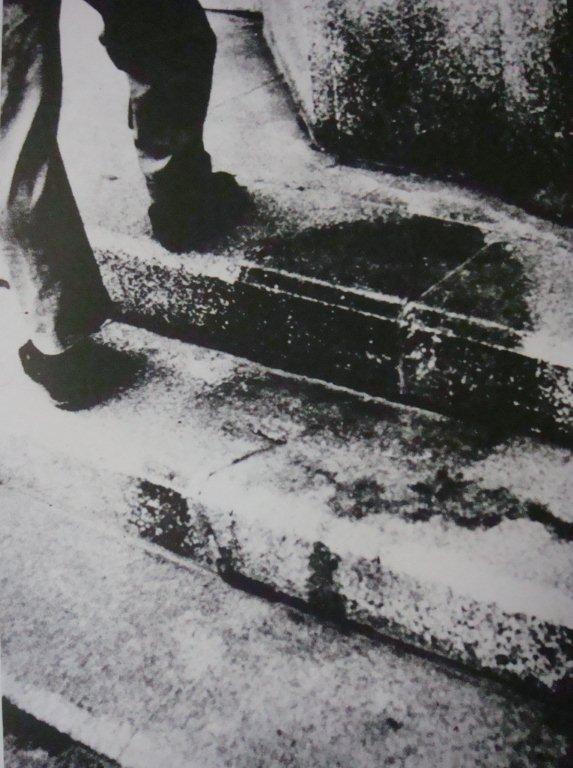
This is the shadow of a man (Shadow burnt into the granite steps.

Within 1.2 kilo-meters of ground zero, those who were directly affected by the heat rays suffered terrible burns and their internal tissues and organs severely damaged. Most of them died instantly or within a few days.

The explosion also created a powerful blast and destroyed most of the wooden houses in 2-kilometer radius of ground zero. People were blown through the air and many crushed to death under collapsed buildings.

Radiation left the human body with serious damage. It penetrated deeply into our bodies, damaged cells and diminished the blood generation function of bone marrow.

It also damaged inner organs. Even those who looked uninjured later became ill and died.

Residual radiation left on the ground affected many long after the explosion. Those who entered the city to search for their families/friends or for relief operations eventually developed similar symptoms and died.

Nuclear weapons are unspeakable weapons. They don’t allow us to live nor die as humans. They are weapons of absolute evil which can never co-exist with human beings.

3.2 million Japanese people lost their lives in the Asia-Pacific War. 20 to 30 million people were victimized by the Japanese military in Asia.

Learning from it, we have acquired the war-renouncing Japanese Constitution. However, military spending in the world is growing. Trillions of dollars are being spent for military purposes. If used for peaceful purposes, this money could solve many problems for human-kind.

20th century war is gone. Our responsibility is to hand over a peaceful and cultivated 21st century to the next generation. I strongly believe that we can hand over a nuclear-weapon-free world to future generations if we work together in solidarity with the people of the U.S. and with the people of the world.

Thank you.

Monday, July 15, 2013

The Summer of Nuclear Resistance: 24 arrested at Kansas City nuclear weapons parts plant

For immediate release July 13, 2013 Contacts: Henry Stoever, 913-375-0045, and Ann Suellentrop, 913-271-7925  PeaceWorks, Kansas City 4509 Walnut, Kansas City, MO 64111

Protesters at new Kansas City facility seek to open a door to a nuclear-weapons-free world. 

On July 13, about 80 persons sang and prayed at the entry road to a new facility in the U.S. nuclear weapons complex. By 10:15 a.m., two dozen protesters had crossed the property line and were soon arrested. The five-building facility, the Kansas City Plant, at 14510 Botts Road in KC, Mo., will by next year house the operations of the current KC Plant (at Bannister and Troost in KC), where 85 percent of the non-nuclear parts for U.S. nuclear weapons are made or procured. During a brief ceremony, the 80 persons pledged “to strive for peace within myself and seek to be a peacemaker in my daily life … to persevere in nonviolence of tongue and heart … to work to abolish war and the causes of war from my own heart and from the face of the earth.”

photo by Bee Lloyd

With the assembly singing “Open the Door,” written for the occasion, 24 persons stepped through a door marked “Open the door to a nuclear-weapons-free world,” the rallying call of the International Campaign to Abolish Nuclear Weapons. These are the 24 who then crossed the line separating the public road from the facility’s property:

Those arrested were:

 --Fr Carl Kabat of St. Louis CW, Oblates of Mary Immaculate (OMI), who had entered the property and been charged with destruction of property in July 2011 and July 2012;

 --Fr William Antone, OMI, of Washington, D.C., the OMI order’s U.S. provincial superior;

 -- From the Kansas City area, including Sister of Charity of Leavenworth Cele Breen, Jim Everett - Independence MO, Lauren Logan, Notre Dame Sister of Omaha Theresa Maly, Community of Christ minister Lu Mountenay, Holy Family CWers Christian Brother Louis Rodemann and Nehemiah Rosell, Kelsey Schmidt, Jane Stoever, Ann Suellentrop, and Georgia Walker;

 -- Frank Cordaro, Ed Bloomer, and Jessica Reznicek - Des Moines IA Catholic Workers

 --Fr William “Bix” Bichsel SJ - Taoma WA CW

 --Mary CW House, Oxford WI, Cassandra Dixon of Madison, WI,

 --Paul Freid of Lake City MN CW Farm --Betsy Keenan - Strangers and Guest CW Farm, Maloy IA

 --Chrissy Kirchhoefer St Louis CW and Anneliese Stoever of St. Louis,

 --Janice Sevre-Duszynska, a Catholic womanpriest of Lexington, KY,

 --Jerry Zawada, a Franciscan priest of Milwaukee, WI.

The 24 line-crossers were arrested, fingerprinted, photographed, and then detained in the Jackson County Police Department. Some were released July 13, some July 14, and some will be released July 15. The resisters received different trial dates, but lawyer Henry Stoever said he would try to secure a single trial date for them.

photo by Bee Lloyd


Zawada, when asked why he crossed the line, said, “It’s the children! And the future of the world. People are blind, people are deaf, to the fact that we’re producing these horrible bombs and creating an atmosphere of fear. It threatens the whole world.” He quoted a statement from deceased Jesuit Richard McSorley: “It’s a sin to build a nuclear weapon.” Zawada also said he wanted to accompany Kabat in this action; Kabat has spent 17 years in prison for acts of civil resistance to nuclear weapons. Referring to Kabat and the whole worldwide community of people seeking a nuke-free world, Zawada said, “It takes passion. And perseverance.”

Maly reflected, “I hope people that have positions of power, the ability to make decisions about nuclear weapons, hear our message.”

###

End Notes: This blog post is the complete news release from PeaceWorks.  Read a National Catholic Reporter article on the Kansas City action by Kate Simmons here.  Click here to see the Facebook page for the action.  

Tuesday, July 2, 2013

The Butterfly and the Submarine

Editor's Introduction: Shelley Douglass and her husband Jim Douglass were among the co-founders of Ground Zero Center for Nonviolent Action, which purchased 3.8 acres bordering Bangor’s Trident nuclear submarine base in 1977. As members of the Pacific Life Community, founded in 1975, they began a campaign of nonviolently resisting the Trident nuclear weapons system. They were inspired by Robert Aldridge’s resignation as a missile designer for Lockheed-Martin (the manufacturer of the Trident submarine launched ballistic missile) following a crisis of conscience as he recognized the first-strike capability and accuracy of the Trident missiles. The Douglasses currently live at Mary’s House Catholic Worker in Birmingham, Alabama, offering hospitality to homeless families and acting for nonviolence and peace.

As we approach the Fourth of July holiday, Shelley offers us a reflection inviting us to nurture our nonviolent heart, and discover (and celebrate) our interdependence.  Happy Interdependence Day to all.


***************
The Butterfly and the Submarine

By Shelley Douglass

This morning I’ve been remembering the beginning of the campaign against Trident submarines in the Pacific Northwest of the USA.  Can it really be almost 40 years ago?  Such a raggedy band we were, twenty or so activists, burned out after our work against the war in Vietnam, not wanting another issue to address – and challenged by Bob Aldridge, who had helped to design the Trident missile.  Bob had left his job because he could no longer in conscience help build Trident.  It was his analysis of the arms race that informed us, but it was his moral action that inspired us.

By the July 4th weekend in 1976, we had done months of research, self-education, and public speaking.  We had formed a small community, which we called Pacific Life Community.  Our commitment was to learn how to live nonviolently, with the campaign against Trident as the political arm of that commitment.  We had all suffered from the personal violence of our own activism – our marriages had suffered, our frantic activity had drained us.  We had all been inspired by some of the people who were on the other side of the issue – like the Air Force men who asked us to raise the issue of targeting civilians during the bombing in Vietnam.  We wanted to struggle against our own complicity in violence at all levels, and to emphasize that everyone is part of the problem and part of the solution – that we can only live, or perish, as one.

The Trident issue made obvious what is deeply true:  none of us are actually independent.  Trident is home ported at Bangor Washington. To cruise the oceans it needs to leave the Strait of Juan de Fuca through Canadian waters, returning on the US side of the border.  The Trident system is a product of years of research and effort that escaped our notice as peace people living within miles of the proposed base.  It was a Trident missile designer who raised the issue for us all.  Trident cruises the Pacific, the same ocean used for testing of nuclear weapons by the US and the French – testing which prompted a movement for a Nuclear Free Pacific.  Deploying Trident is an international project; stopping it is also.  (Since those early years of the Trident campaign, Scotland has become a center of opposition as well, to the British Trident.)

A very early demonstration against Trident saw an international community gathered at Peace Arch Park, the border crossing between the US and Canada just above Blaine, WA.  We gathered from the US and the Canadian sides of the border to celebrate INTERdependence Day during the 4th of July weekend. Citizens of the US and Canada and perhaps other countries began by affirming interdependence at the border, and continued by going to the site of the base itself and reclaiming the land for all people.  Of course, there were arrests and trials and some jail time, which further raised the issue.

Interdependence:  a good thing to celebrate, especially at this time of fracture and hostility.  During the years that have passed since the Trident campaign began, it has only become clearer that the issues are not national but global.  Corporations and governments think globally; more and more often, movements do, too.  In this sense we’re living into Dr. King’s vision.  King’s hope for the Poor People’s Campaign was that as poor people tied up DC calling for legislation to end poverty, the peace movement would encircle the Pentagon calling for peace, and then that peoples around the globe would join in similar nonviolent blockages until global peace and justice became a possibility. 

I was having a good time at morning prayer this morning remembering those early actions of ours, and thinking that our commitment to nonviolence as a way of life and our understanding of interdependence are both as valid now as they were then.  The ubiquitous butterfly fluttered into my mind – you know, the one that changes the weather in Bali by fluttering its wings in England?  Interdependence is a scientific fact now too.  Life is a mystery, and so is our linkage to each other, yet that linkage is there, strong as life.

It occurred to me that the linkage symbolized by the butterfly, or more grossly by the Trident navigating global waters, is the basis for the hard sayings of Jesus that we’ve been reading in church over the last few weeks.  What if not only my actions but my thoughts affect the world, just as the butterfly’s wings do?  What if my hatred or impatience or fear affects the “weather” in other people’s psyches?  I have certainly experienced those effects in a local way – when someone in the house is grouchy or touchy, for example, everyone’s spirits are affected badly.  What if that’s just as true on a larger, less visible level?

As I sit thinking, it becomes obvious – ill will generates ill will, distrust generates distrust.  Lack of respect calls forth an answering lack of respect.  I see it in our political arena all the time, as civility and reason fly out the window.  I feel it in my own heart, where I battle cynicism and hostility daily as I read the paper or watch the news.  All too often my interior response to hostility is a mental “back atcha” or  “so’s your mama”.  It doesn’t get said, but it has an interior effect, a kind of gunk of the soul, that stays with me for hours.  What if the hostility that I harbor affects not only the people here in the house, but the web of life in the world?  What if my ill will helps impel a Syrian soldier to pull a trigger?

All of which brings me back to the spiritual disciplines represented by morning prayer or scripture reading or examination of conscience.  Jesus wasn’t telling us to love our enemy so that we would be nice people, or even so that our enemies would be nice people.  He was setting out for us the very difficult way to change in the world.  Those examinations of conscience that require us to list our lies, or lack of charity, our hateful actions – perhaps they aren’t so much intended to guide us to personal perfection as to point out to us the ways in which we ourselves foment war and injustice.  Perhaps it isn’t so much that my anomie or my resentment hurts me (although it does), but that it hurts us all.  It fosters disturbance in the delicate balance that would be peace in the world, peace in our minds.

Gandhi told people to BE the change they wanted to see in the world; Peter Maurin observed that if everyone would be what they wanted the other person to be, the world would be a better place.  What if we took an examination of conscience seriously, not as a litany of our sins, not to be perfect in following rules, but as a guideline to the ways in which we ourselves are responsible for the evil in the world?  What if we took our own sin seriously?

The butterfly’s wing, the hateful thought, the submarine, the hands across a border – all signs of our interdependence, which could be our salvation.

Shelley & Jim (at right) with friends at the Y-12 Complex in July 2010

Friday, June 7, 2013

ASK YOUR MAYOR TO CO-SPONSOR A BOLD NEW RESOLUTION TO ELIMINATE NUCLEAR WEAPONS

An important request from Jackie Cabasso on behalf of Mayors for Peace.  Please note that she needs responses by June 20th, before the start of the U.S. Conference of Mayors annual meeting. Thanks!!!

*************

ASK YOUR MAYOR TO CO-SPONSOR A BOLD NEW RESOLUTION, "CALLING FOR U.S. LEADERSHIP IN GLOBAL ELIMINATION OF NUCLEAR WEAPONS AND REDIRECTION OF MILITARY SPENDING TO DOMESTIC NEEDS”!


The U.S. Conference of Mayors (USCM), the nonpartisan association of U.S. cities with populations over 30,000, will be considering this resolution at its June 21 – 22 annual meeting in Las Vegas. The resolution’s lead sponsor is Mayor Donald Plusquellic of Akron, Ohio, a past President of the USCM. Mayor Plusquellic is also a Vice-President of Mayors for Peace, an international association lead by the Mayors of Hiroshima and Nagasaki, with over 5,600 members in 156 countries - 197 in the U.S. To see the resolution's growing list of co-sponsors click here.

 The USCM has regularly adopted resolutions since 2004 calling for the commencement of comprehensive nuclear disarmament negotiations to be concluded and implemented by 2020, as proposed by Mayors for Peace. For the past three years, the USCM has also called for deep cuts in nuclear weapons spending and redirection of those funds to meet the needs of cities, and in 2011 adopted an additional resolution, “Calling on Congress to Redirect Military Spending to Domestic Needs.”

 This year’s resolution breaks new ground by combining all of these elements in a comprehensive package. The resolution is a fact-filled educational resource that can be used at the local level as an excellent organizing tool! Read the resolution here.

 Help us get as many co-sponsoring mayors as possible! Your mayor does not have to be a member of Mayors for Peace to be a sponsor, but this is a great opportunity to ask her/him to join.

 Ask your mayor to endorse the resolution! You can download a terrific “Dear Colleague” letter from Mayor Plusquellic here. Please have your mayor send an e-mail message stating her/his desire endorse to both Akron Deputy Mayor Rick Merolla at RMerolla@akronohio.gov AND to me at jackie@2020visioncampaign.org by COB June 20.

 To find out if your mayor is a member of Mayors for Peace and see what year the city joined, click here.

 If your mayor is not a member of Mayors for Peace, ask her/him to join! It’s easy. For instructions, click here.

 For more information about Mayors for Peace, see www.mayorsforpeace.org and www.2020visioncampaign.org. For more information about the USCM see www.usmayors.org.
Still have questions? Need help? Contact Jackie Cabasso, Mayors for Peace North American Coordinator; Executive Director, Western States Legal Foundation; Convener, UFPJ Nuclear Disarmament/Redefining Security Working Group jackie@2020visioncampaign.org; (510) 839-5877